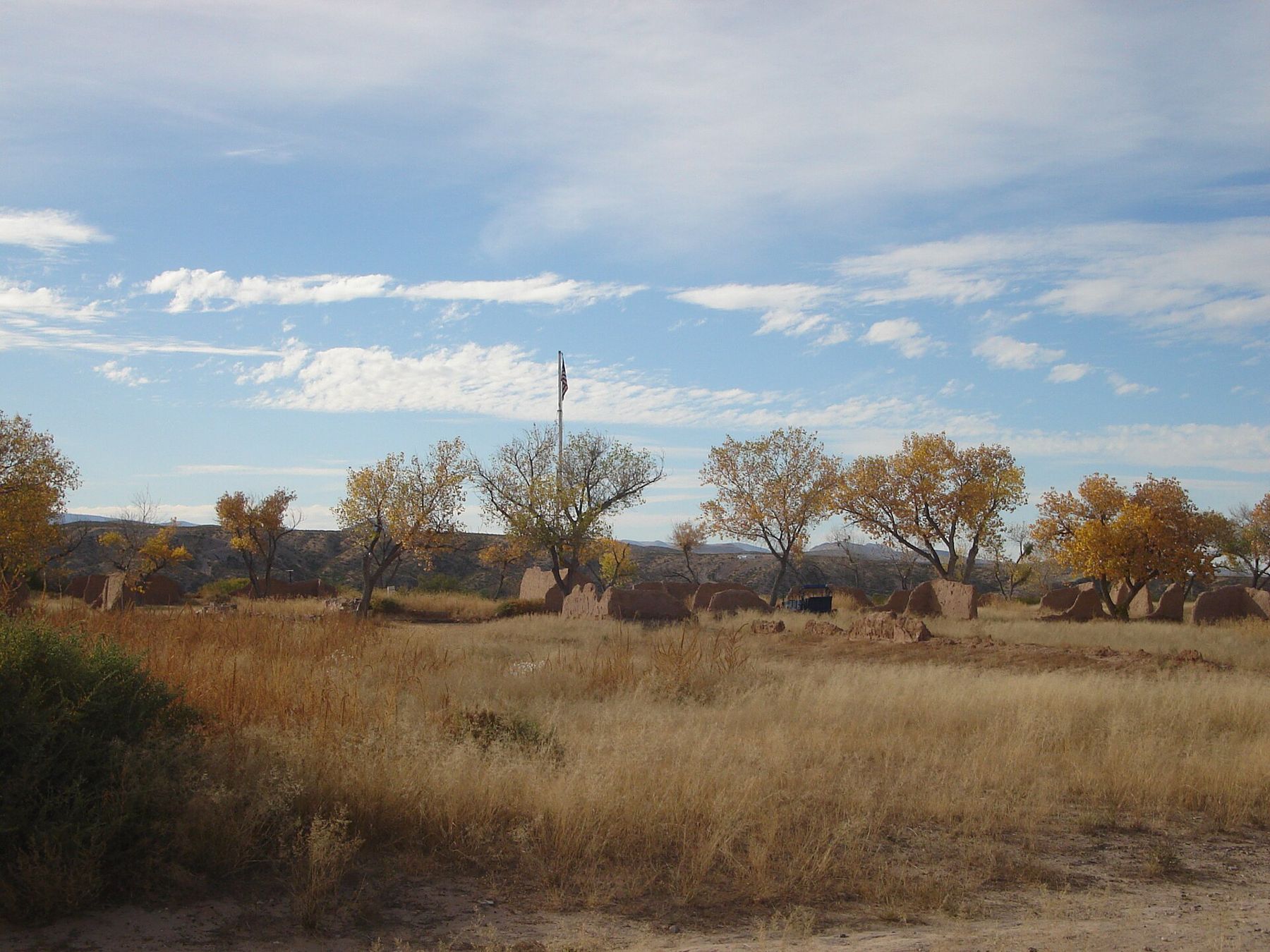
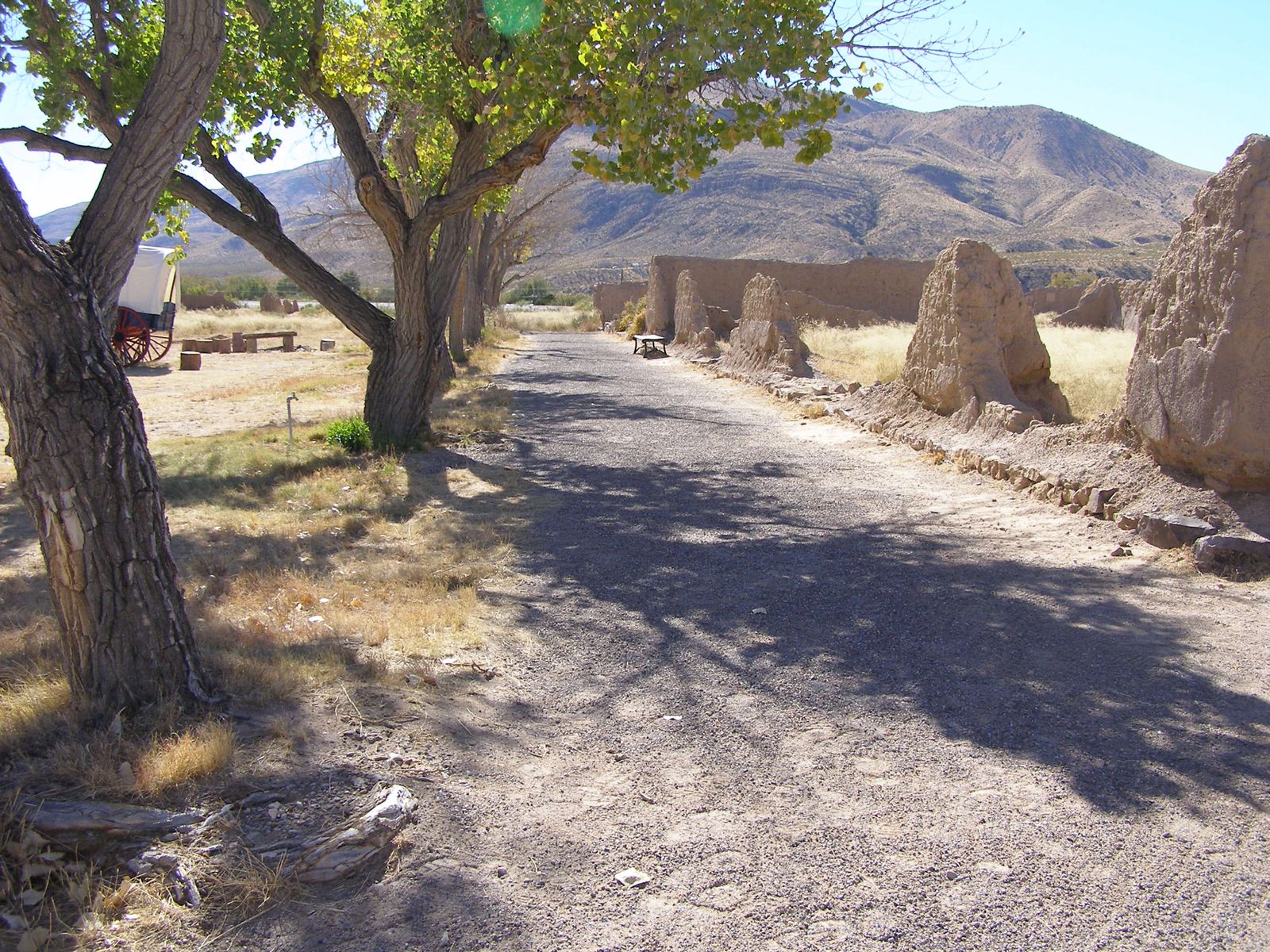
Twenty minutes north of Las Cruces on I-25, the Mesilla Valley narrows as the Rio Grande comes out of Selden Canyon. On a terrace above the river, among cottonwoods and creosote, stand the eroded adobe walls of Fort Selden. They are rounded and softened now, some of them knee high, some still taller than a person, with the outlines of rooms and doorways still clear.
The fort is a state historic site with a small visitor center, a walking trail through the ruins and a calm view over the valley. It makes a good short outing on its own, or a stop on the way north to Hatch and the chile harvest.
Why a fort here
The army built Fort Selden in 1865, as the Civil War was ending. Its job was to protect settlers in the Mesilla Valley and travellers on the main road north. Just upstream, that road left the Rio Grande to cross the Jornada del Muerto, the long waterless stretch on the old Camino Real, and wagon trains, stagecoaches and freight outfits all passed this way. Apache bands still resisted the American advance into their homeland, and the region was contested ground.
The fort was garrisoned off and on for about a quarter of a century. It was briefly abandoned in the late 1870s, reoccupied, and finally closed in the early 1890s, once the railroad had arrived and the conflicts of the frontier had ended. The longer story of the road and the valley is told in how Mesilla changed countries.
Buffalo Soldiers and a famous boyhood
Among the troops stationed at Fort Selden were Black soldiers of the regiments formed after the Civil War, the men who became known as Buffalo Soldiers. They served at posts across the Southwest, escorting travellers, patrolling roads and building forts like this one, often in hard conditions and with little recognition. The visitor center tells part of their story, and it is one of the main reasons to come.
The fort has another well-known resident. In the 1880s Captain Arthur MacArthur commanded the post, and his young son Douglas, who later became one of the best-known American generals of the twentieth century, spent several years of his childhood here. It is easy to picture a small boy running across this parade ground, with the river and the mountains all around.
Life at the post was plain and often hard for everyone in it. Soldiers drilled, cut wood, hauled water from the river and rode long patrols in the heat. Officers' families lived in adobe quarters close to the parade ground. Laundresses, cooks and traders worked alongside the garrison, and the village that grew up nearby supplied food, forage and company. The visitor center's exhibits fill in many of these ordinary lives.
 Down another streetA day around the Mesilla plaza
Walls returning to earth
Fort Selden was built of adobe, sun-dried bricks made of mud and straw, laid on stone foundations and plastered to keep out the weather. Adobe is cool in summer and warm in winter, and it was cheap and easy to make on site. It also needs constant care. Once the army left and the roofs were taken or fell in, rain began to wash the walls away, and they have been melting slowly back into the ground ever since.
Today the site's staff use protective caps and careful repairs to slow the process, but the ruins are still changing. That is part of their appeal. You are looking at a building in the middle of returning to the earth, and the softened shapes show exactly how adobe weathers. Stay on the paths, do not climb on the walls, and do not take anything away.
Visiting the ruins
A trail loops through the site past barracks, officers' quarters, the hospital and the parade ground, with signs explaining what each set of walls once was. The visitor center has exhibits on the fort's soldiers and families and on daily life at a frontier post. Opening days, hours and any entry fee change from time to time, so check before you go.
- Heat: there is little shade among the ruins. In summer, come in the morning.
- Wind: spring afternoons can be gusty and dusty in the valley.
- Wildlife: watch for rattlesnakes in warm months, and keep to the paths.
- Events: the site sometimes holds living history days with costumed demonstrations; look for current listings.
Around the fort
Next to the fort, Leasburg Dam State Park sits on the river by a small diversion dam that sends water into the irrigation canals of the valley. It has a campground, picnic shelters and short trails along the Rio Grande. When the irrigation season is running, the river here can be a good place to watch herons and other water birds; when the water is off, the channel may be little more than sand.
The surrounding desert is part of the broad federal lands of the region, and the long ridge of the Robledo Mountains rises across the river to the west. From the fort's terrace you can see how the valley pinches shut here, which is exactly why the road, the river, the railroad and now the interstate all squeeze through the same gap.
The drive back south takes you through farmland and pecan orchards, the valley described in the pecan orchards of the Mesilla Valley. If you have time, follow the old highway on the west side of the river instead of the interstate, through small farm villages, for a slower and greener view of the same country.